
Quick Answer
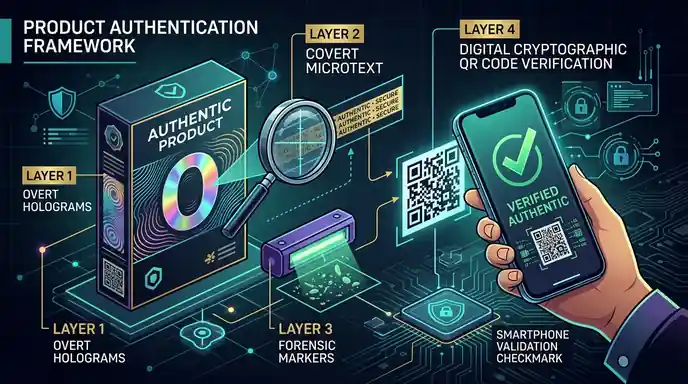
Product authentication is the formal process of verifying that a physical good is genuine, authorized, and produced by its legitimate trademark owner. Modern authentication relies on four complementary technology tiers: overt physical features (visible holograms and color-shifting inks), covert markers (microtext and invisible UV pigments), forensic markers (chemical taggants), and digital serialization (cryptographic QR codes and cloud telemetry).
Understanding Product Authentication: The Core Definition
In modern global commerce, brand reputation and consumer safety hinge on an deceptively simple question: Is this product real?
According to ISO 12931:2012—the international standard establishing performance criteria for authentication solutions—product authentication is defined as the process of verifying whether a tangible item originates from the claimed legitimate source and satisfies the manufacturer’s authentic specifications.
Historically, authentication was an analog concern. Watchmakers engraved hallmark stamps into solid gold casebacks; silversmiths struck guild hallmarks into sterling spoons. Today, counterfeiters operate multi-million-dollar transnational syndicates capable of reverse-engineering packaging foils, reproducing custom plastic closures, and synthesizing identical cosmetic scents.
To defend their revenues, customer trust, and regulatory compliance, enterprises must understand the taxonomy of product authentication, the limitations of legacy physical barriers, and the transition toward connected, cryptographic digital architectures.
Identification vs. Verification vs. Authentication
In supply chain discussions, the terms identification, verification, and authentication are often mistakenly used as interchangeable synonyms. In security engineering, however, they represent distinctly different operational tiers:
+-------------------------------------------------------------------------------+
|                      THE PRODUCT INTEGRITY TAXONOMY                           |
|                                                                               |
|  [Tier 1: Identification] -> "What SKU is this?"                              |
|                              Standard UPC / EAN Barcode                       |
|                              No uniqueness, no security, easily photocopied   |
|                                                                               |
|  [Tier 2: Verification]   -> "Does this serial number match our registry?"    |
|                              Serialized Data Matrix / Serial Number           |
|                              Confirms existence in brand database             |
|                                                                               |
|  [Tier 3: Authentication] -> "Is this exact physical unit genuine & valid?"  |
|                              Cryptographic Token + Scan Telemetry             |
|                              Evaluates duplicate scans, velocity, and state   |
+-------------------------------------------------------------------------------+- Identification: Tells systems what category of product is present. A standard 1D barcode on a bottle of shampoo tells the cash register it costs $12.99. It provides zero proof of origin.
- Verification: Confirms that a given serial number matches an issued manufacturing batch. While superior to static barcodes, simple verification can still be tricked if an attacker photocopies a valid serial number onto 10,000 fake containers.
- Authentication: Proves the validity of the specific physical instance in hand. True authentication combines item identity with behavioral context: Has this code been scanned before? In what geographic coordinates? Is the session cryptographic nonce valid? Does it display expected forensic attributes?
Deploying an integrated product verification system bridges verification and authentication, turning a static package into an interactive security sensor.
The Four Technological Tiers of Product Authentication
Industry standards (including ISO 12931 and WIPO frameworks) classify authentication technologies into four distinct levels based on who inspects them and what tools are required:
=================================================================================
TIER 1: OVERT (Level 1)
  Target: General Public & Retail Cashiers
  Tools Required: None (Human Senses)
  Examples: Holograms, Color-Shifting Optically Variable Inks (OVI), Lenticular Film
---------------------------------------------------------------------------------
TIER 2: COVERT (Level 2)
  Target: Brand Field Inspectors & Customs Agents
  Tools Required: Simple Handheld Devices (UV Blacklight, Magnifier, Polarizer)
  Examples: Fluorescent Invisible Inks, Microtext, Hidden Guilloche Patterns
---------------------------------------------------------------------------------
TIER 3: FORENSIC (Level 3)
  Target: Expert Laboratories & Regulatory Test Facilities
  Tools Required: Scientific Equipment (Mass Spectrometer, PCR Sequencer)
  Examples: Synthetic DNA Markers, Isotope Ratios, Nanotag Chemical Tracers
---------------------------------------------------------------------------------
TIER 4: DIGITAL (Level 4)
  Target: Universal (Consumers, Distributors, Enterprise Analytics)
  Tools Required: Any Smartphone Camera / Web Browser
  Examples: Cryptographic Serialized QR, NFC Cryptographic Chips, Dynamic Telemetry
=================================================================================
1. Overt Features (Visible to the Naked Eye)
Overt security features allow everyday consumers to make immediate authenticity judgments without training:
- Holograms and Diffractive Optically Variable Image Devices (DOVIDs): Multi-layered holographic seals showing 3D depth, kinetic movement, and color alternation when tilted.
- Optically Variable Inks (OVI): Micro-flake inks that shift dramatically between distinct shades (e.g., magenta to green) depending on the angle of incoming light.
- Lenticular Packaging Effects: Precision-embossed microscopic lenses that display alternating graphics when viewed from different angles.
Vulnerability: Counterfeiters in specialized industrial zones can now replicate standard commercial holograms within weeks of a product release.
2. Covert Features (Hidden but Readily Testable)
Covert mechanisms require simple field tools to reveal:
- Ultraviolet (UV) Fluorescent Pigments: Inks invisible under normal daylight that illuminate with bright green, blue, or orange luminescence under 365nm blacklight.
- Micro-Typography: Lines of artwork that appear as solid border rules to the naked eye but resolve into legible microtext (under 0.2mm) when magnified.
- Polarizing and Metameric Inks: Color pairs that look identical under daylight but diverge under specific polarized filtration.
Vulnerability: Illicit manufacturing lines frequently acquire basic UV inks, compromising Level 2 security if inspectors do not verify variable wavelengths.
3. Forensic Features (Laboratory Grade)
When high-stakes litigation or multi-million-dollar customs disputes occur, brands rely on forensic markers:
- Bio-Engineered DNA Tagging: Infusing synthetic, scrambled DNA oligomers into textile dyes or luxury inks that require Polymerase Chain Reaction (PCR) molecular amplification to confirm.
- Chemical Isotopic Fingerprinting: Measuring naturally occurring trace elemental ratios in raw materials (e.g., wine, cotton, or cacao) to prove geographic origin.
Vulnerability: Forensic tests cost hundreds to thousands of dollars per sample and take days or weeks—completely useless for a consumer shopping in a store.
4. Digital Serialization & Smartphone Telemetry
Digital authentication transforms the security paradigm. Instead of relying on passive physical tricks that counterfeiters will eventually reverse-engineer, digital systems leverage mathematical cryptography and cloud infrastructure:
- Dynamic Serialized 2D Codes: Every bottle or carton receives a globally unique, mathematically unpredictable identifier.
- No App Download Required: Using native smartphone operating system cameras, consumers scan and verify directly in mobile browsers.
- Algorithmic Anomaly Detection: The cloud backend analyzes scan coordinates, IP velocity, browser user-agents, and scan frequency to identify cloned packaging in real time.
The Shift from Passive Physical to Active Digital Authentication
Why are Fortune 500 consumer brands across supplements, luxury, cosmetics, and electronics moving aggressively away from standalone holograms and toward digital verification?
The fundamental limitation of physical authentication is that physical markers are silent. If a criminal syndicate successfully counterfeits a holographic sticker:
- The brand owner has no idea fakes are circulating.
- The retailer has no way to detect commingled stock.
- The consumer is falsely reassured by the fake hologram.
Digital systems, by contrast, are active and intelligent. When a brand integrates an anti counterfeit qr code system, every scan generates actionable intelligence. If counterfeiters photocopy an authentic serialized label 5,000 times, the first scan validates successfully. The second, third, and four-hundredth scans trigger automated alert flags:
Duplicate Scan Detection Event:
  Product: Advanced Whey Protein 2kg (Serial: #TX-882194)
  Scan #1: London, UK (Sep 10, 10:14 AM) -> Status: VALID
  Scan #2: Riyadh, Saudi Arabia (Sep 10, 10:19 AM) -> Status: ALERT (Velocity Error)
  Scan #3: Istanbul, Turkey (Sep 10, 10:25 AM) -> Status: WARNING (Duplicate Flag)
  Action: Serial #TX-882194 automatically quarantined; consumer shown counterfeit alert.
Discovering how qr product verification works allows brand protection teams to pinpoint the exact cities, markets, and retail outlets where illicit goods are penetrating their distribution chains.
Key Criteria for Selecting an Authentication System
When evaluating product authentication architectures, enterprises must evaluate six critical vectors:
- Security Robustness: Does the technology rely on secrecy (which fails once leaked) or mathematical cryptography (which remains secure even when observed)?
- Consumer Friction: Does authentication require downloading a proprietary iOS/Android mobile app? Solutions requiring app downloads suffer user participation rates under 2%. Frictionless browser scanning achieves participation rates between 15% and 35%.
- Packaging Line Compatibility: Can the serialization be applied at existing production speeds (200–800 units/min) using thermal inkjet or digital offset printing without slowing throughput?
- Unit Economic Cost: Is the per-unit cost viable for high-volume consumer packaged goods (CPG)? Physical NFC tags ($0.15–$0.40) work for luxury handbags but fail for $15 cosmetics or $3 beverages. Digital QR serialization costs fractions of a cent per unit.
- Actionable Business Telemetry: Does the system provide a brand dashboard showing scan geography, distributor compliance, diversion signals, and consumer engagement analytics?
- Regulatory Compliance Readiness: Does the data model support emerging mandates such as GS1 Digital Link, the EU Digital Product Passport (DPP), and regional serialized pharmaceutical standards?
Sources & Further Reading
- ISO 12931:2012 — Performance criteria for authentication solutions for anti-counterfeiting in the field of tangible goods
- International AntiCounterfeiting Coalition (IACC) — Counterfeiting Statistics & Technological Solutions
- World Intellectual Property Organization (WIPO) — Building Respect for IP & Brand Protection Strategies
- OECD — Mapping Global Trade in Fakes 2025: Trends and Enforcement Frameworks
- EUIPO European Observatory on Infringements of Intellectual Property Rights — Tech Watch on Anti-Counterfeiting
Related TrustQR pages
Enterprise Product Authentication Solution
Protect your high-value physical products with smartphone-native authentication, cryptographic serialization, and instant buyer trust.
Explore our product authentication solution
How QR Code Product Verification Works
Step inside the verification pipeline: from label generation and variable printing to cloud validation and consumer scan telemetry.
Learn how product verification works
Enterprise Anti-Counterfeit System
Detect duplicate scans, monitor illicit distribution routes, and safeguard brand equity with active anti-counterfeiting infrastructure.