
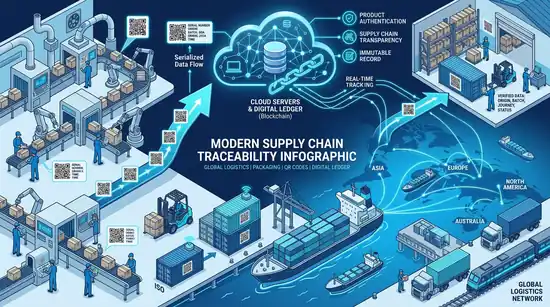
Quick Answer
QR codes for product traceability bridge physical items and digital cloud databases by embedding item-level serial identifiers, batch lot codes, and standardized web URIs. Unlike legacy 1D UPC barcodes that only identify generic SKU categories, 2D traceability QR codes enable granular custody handoffs, instant recall isolation, and consumer-facing smartphone authentication.
The Sunset of the Linear Barcode and the Rise of 2D Traceability
For over half a century, the linear UPC/EAN barcode reigned as the universal language of retail commerce. First scanned on a pack of Wrigley’s chewing gum in Ohio in 1974, the one-dimensional barcode solved a single operational problem: speeding up supermarket checkout lines.
However, modern global supply chains operate in an era defined by stringent cross-border regulatory compliance, volatile multi-tier logistics networks, widespread counterfeit exposure, and heightened consumer demand for ESG (environmental, social, and governance) transparency. A standard linear barcode encodes only a generic product category—it cannot tell a warehouse manager when an item was bottled, which specific pallet it belonged to, whether it was diverted into an unauthorized territory, or whether it is authentic.
Enter 2D matrices, led by the Quick Response (QR) code. Through initiatives like GS1’s Sunrise 2027, the global retail industry is systematically upgrading point-of-sale scanners to transition from 1D barcodes to 2D data carriers. QR codes for product traceability have shifted from optional marketing novelties into core enterprise infrastructure.
Architectural Breakdown: How Traceability QR Codes Function
At its foundational level, a traceability QR code acts as a physical hyperlink that connects an individual manufactured unit to a living digital thread.
+-------------------------------------------------------------------------------+
|                      TRACEABILITY EVENT DATA ARCHITECTURE                     |
|                                                                               |
|  [Physical Unit]                                                              |
|       │                                                                       |
|  [2D Data Matrix / QR] -> Encodes GS1 Digital Link URI                        |
|       │                    https://id.brand.com/01/GTIN/21/SERIAL?10=LOT      |
|       ▼                                                                       |
|  [Scanner Event]       -> Warehouse Handheld / Retail PoS / Consumer Phone    |
|       │                                                                       |
|  [EPCIS Event Core]    -> What: Product GTIN + Unique Serial Number           |
|                           When: 2026-09-10T14:32:00Z                          |
|                           Where: GLN (Global Location Number) 4012345000018   |
|                           Why: Packaging / Shipping / Verification (BizStep)  |
|       ▼                                                                       |
|  [Cloud Registry]      -> Live Authenticity, Provenance, & Anti-Diversion     |
+-------------------------------------------------------------------------------+
The GS1 Digital Link Standard
Traditionally, putting a QR code on a package alongside a 1D barcode created confusion: cashiers accidentally scanned the QR code, while consumers could not interact with the barcode.
The GS1 Digital Link standard solves this by structuring web URLs using GS1 Application Identifiers (AIs). Instead of a proprietary redirect, the URL follows a strict syntax:
https://brand.example.com/01/{GTIN}/21/{SERIAL}?10={LOT}&17={EXPIRY}
- Key (01): The Global Trade Item Number (GTIN) that identifies the product SKU.
- Key (21): The item-level unique serial number.
- Key (10): The production batch/lot number.
- Key (17): The expiration date (YYMMDD format).
When scanned by a point-of-sale optical scanner, the system extracts the GTIN for pricing and inventory deduction. When scanned by a consumer’s native smartphone camera, the device’s web browser resolves the URL to display real-time provenance, ingredient sourcing data, and immediate confirmation via a product verification system.
Batch-Level Tracking vs. Item-Level Serialization
One of the most consequential decisions an operations executive faces is choosing the granularity of their traceability deployment.
| Dimension | Batch-Level Traceability | Item-Level Serialization |
|---|---|---|
| Identifier Scope | 1 code shared across 10,000–100,000 units | 1 unique cryptographic code per individual package |
| Recall Resolution | Broad (Entire production shift discarded) | Surgical (Only affected units recalled) |
| Counterfeit Detection | Ineffective (Illicit actors clone the batch code) | Complete (Duplicate scans trigger security alerts) |
| Grey-Market Diversion | Inconclusive across distributed markets | Pinpoints exact distributor or retail leak point |
| Printing Complexity | Low (Static litho/flexo print plate runs) | Requires continuous inline digital printing / laser |
| Consumer Experience | Generic batch info or promotional landing page | Personalized authenticity & unboxing journey |
The High Cost of Coarse Traceability
Consider an infant formula manufacturer that discovers a potential bacterial contamination in a packaging valve. Under batch-level tracking, the company must initiate a recall covering every can produced over a two-week run—destroying 400,000 units, forfeiting millions of dollars, and inflicting severe brand damage.
With item-level serialization implemented alongside an anti counterfeit system, the manufacturer can isolate the malfunction to the precise 42-minute window when the valve pressure dropped. Instead of recalling 400,000 units, they surgically recall 1,240 serialized cans. Furthermore, if any affected can is scanned at retail checkout or by a parent at home, the system instantly flashes a bold safety warning, blocking consumption.
Real-World Case Studies by Industry
1. Pharmaceuticals: Combating Black-Market Diversion
Under the U.S. FDA Drug Supply Chain Security Act (DSCSA) and the EU Falsified Medicines Directive (FMD), prescription medications require 2D barcodes encoding unit serial numbers.
Pharmaceutical manufacturers utilize this data to combat grey-market diversion. When serialized cartons designated for developing markets are illicitly redirected to high-price European pharmacies, intermediate scans reveal unexpected custody hops. Integrating serialized QR codes with a robust product authentication platform allows manufacturers to automatically revoke compromised serial numbers before patients ingest unauthorized formulas.
2. High-Value Food, Supplements, and Wine: From Farm to Bottle
Premium agricultural and nutritional brands face rampant fraud. Olive oil, Manuka honey, and fine wines are routinely diluted or refilled.
- Leading wine producers now embed serialized micro-QR codes across tamper-evident neck capsules.
- Scanning the capsule reveals the specific vineyard parcel, bottling timestamp, and distribution importer.
- If a refilled bottle has its code scanned multiple times across separate metropolitan areas, scan telemetry exposes the scam. Learning how qr product verification works enables wineries to maintain brand equity in notoriously vulnerable export markets like Southeast Asia and the Gulf.
3. Fashion & Luxury: The EU Digital Product Passport (DPP)
Under the European Union’s Ecodesign for Sustainable Products Regulation (ESPR), textiles and luxury goods entering the European single market will soon mandate an interoperable Digital Product Passport.
Traceability QR codes printed on internal garment tags or embedded inside leather goods store:
- Origin of raw materials (organic cotton certifications, leather tannery environmental ratings).
- Carbon footprint metrics across manufacturing tiers.
- Repairability guidelines, authorized service history, and circular recycling instructions.
- Proof of genuine ownership for peer-to-peer secondary resale marketplaces.
Technical Implementation: 4 Core Infrastructure Pillars
Deploying enterprise-scale traceability via QR codes requires alignment across four engineering domains:
[1. Packaging & Line Integration]  -> High-speed CIJ, Thermal Inkjet, or Digital Presses
                                            │
[2. Edge Computing & Aggregation]  -> Unit-to-Bundle-to-Case-to-Pallet Parent/Child Mapping
                                            │
[3. Core Event Processing (EPCIS)] -> Capture Object, Aggregation, and Transaction Events
                                            │
[4. Telemetry & Analytics Engine]  -> Cloud APIs, Verification Dashboards, and Anomaly Alerts
1. Line-Speed Printing and Vision Verification
High-speed production lines operate at speeds of 200 to 1,200 units per minute. Generating unique QR codes at these velocities demands industrial thermal inkjet (TIJ), continuous inkjet (CIJ), or UV-curable laser ablation systems. High-speed vision inspection cameras positioned immediately downstream must grade every printed code against ISO/IEC 15415 grading standards (evaluating contrast, modulation, and axial non-uniformity) to eject unreadable labels before cartons leave the facility.
2. Packaging Aggregation (Parent-Child Hierarchy)
Traceability cannot rely solely on scanning individual units in a shipping container. Efficient logistics requires aggregation:
- Child: 24 serialized individual bottles.
- Parent: 1 serialized inner case carton.
- Grandparent: 1 serialized pallet with an SSCC (Serial Shipping Container Code) barcode.
When the warehouse scans the pallet’s master QR code, the software automatically associates all 2,400 child serial numbers with that logistics movement without breaking shrink wrap.
3. Data Governance and Scalable Cloud Registries
Storing billions of serialized records across decades requires high-throughput, low-latency datastores. Event records should adhere to the GS1 EPCIS 2.0 (Electronic Product Code Information Services) standard, capturing the four foundational dimensions: What (GTIN/Serial), When (Timestamp), Where (Read point/GLN), and Why (Business step).
4 Common Pitfalls in QR Traceability Deployments
- Printing Static Redirect URLs: The most frequent failure is printing a fixed company URL without variable query parameters. Once printed, you lose all unit-level visibility and can never perform surgical recalls.
- Ignoring Code Contrast and Quiet Zones: Designing dark packaging with inverted QR codes (white matrix on a colored background) or trimming the mandatory “quiet zone” border causes optical scan failure rates to spike by up to 30% on legacy smartphones.
- Failing to Protect Verification Endpoints: If your QR code links to an unprotected web form without cryptographic nonce tokens or rate-limiting, bad actors can crawl your database, discover valid serial sequences, and print counterfeit labels matching real active units.
- Neglecting the Consumer Value Proposition: A traceability code that displays only raw technical metadata bores the end-consumer. Pair regulatory traceability with genuine consumer utility: warranty registration, unboxing instructions, loyalty rewards, or immediate authenticity certificates.
Sources & Further Reading
- GS1 Standards Organization — GS1 Digital Link Standard Specification
- ISO/IEC 18004:2024 — Information Technology: Automatic Identification and Data Capture Techniques (QR Code Symbology)
- U.S. Food and Drug Administration — Drug Supply Chain Security Act (DSCSA) Overview
- European Commission — Ecodesign for Sustainable Products Regulation (ESPR) & Digital Product Passport
- World Economic Forum — Advancing Traceability in Global Supply Chains
Related TrustQR pages
Product Verification System Architecture
Explore how TrustQR transforms serialized 2D codes into high-performance product verification and digital touchpoints.
Explore our product verification system
Enterprise Product Authentication Solutions
Safeguard customer safety and defend your brand against counterfeit infiltration with intelligent product authentication.
Learn about product authentication
Active Anti-Counterfeit Features
Deploy duplicate scan detection, scan velocity triggers, and geolocation analytics on top of your existing packaging workflows.