
Quick Answer
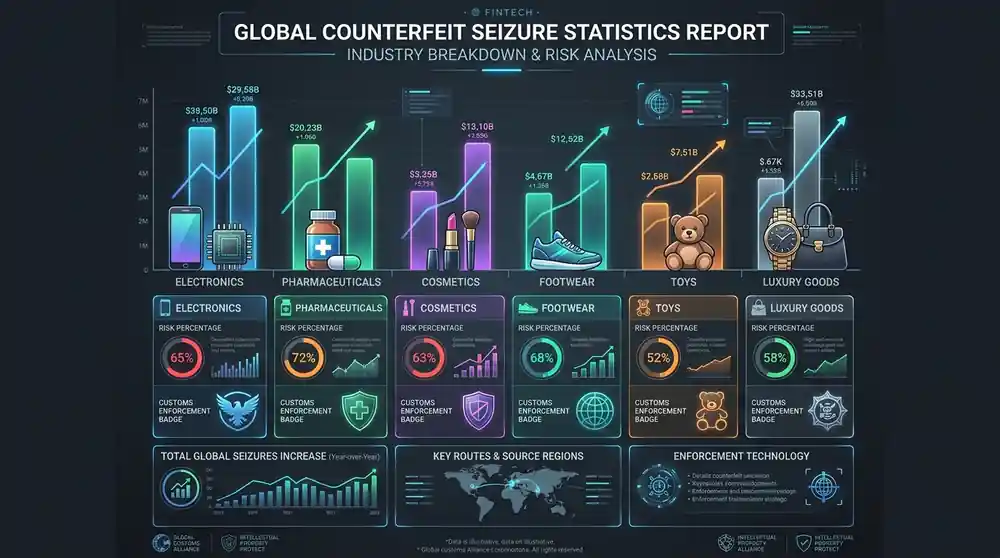
Apparel, footwear, and luxury leather goods account for over 50% of global counterfeit customs seizures by volume, followed closely by consumer electronics, personal care cosmetics, pharmaceuticals, and automotive components. According to joint OECD-EUIPO and U.S. CBP customs data, cross-border counterfeit trade exceeds $467 billion annually, with small postal and courier parcels representing more than 80% of all border detentions.
Executive Summary: Mapping the Multi-Billion-Dollar Seizure Landscape
Counterfeiting is no longer confined to luxury handbags sold on street corners. Today, it is an industrialized, multi-sector illicit economy that attacks high-margin consumer products, mission-critical industrial components, and lifesaving medical goods alike.
Synthesizing the latest enforcement reports from the OECD, the European Union Intellectual Property Office (EUIPO), U.S. Customs and Border Protection (CBP), and the World Customs Organization (WCO), this report provides a comprehensive, data-driven breakdown of global counterfeit seizures by industry, shipping modality, and consumer risk profiles.
+-------------------------------------------------------------------------------+
|             GLOBAL COUNTERFEIT SEIZURES BY INDUSTRY (% OF VOLUME)             |
|                                                                               |
|  Footwear & Athletic Apparel       [████████████████████████████]  38%        |
|  Luxury Goods & Leatherwear        [██████████████]                18%        |
|  Consumer Tech & Accessories       [██████████]                    13%        |
|  Cosmetics, Perfumery & Bodycare   [███████]                       10%        |
|  Pharmaceuticals & Healthcare      [█████]                          7%        |
|  Automotive & Critical Machinery   [████]                           5%        |
|  Toys, Games & Sporting Goods      [████]                           5%        |
|  Food, Premium Wine & Spirits      [███]                            4%        |
+-------------------------------------------------------------------------------+
*Source: Aggregated OECD-EUIPO 2025/2026 customs seizure datasets & U.S. CBP IPR enforcement filings.
1. Footwear, Apparel, and Luxury Leather Goods (56% Combined)
Footwear and athletic apparel remain the undisputed volume leaders of counterfeit trade worldwide. In both U.S. and European enforcement statistics, counterfeit sneakers, designer streetwear, and luxury handbags represent over half of all physical seizures.
Key Data Points:
- U.S. CBP FY 2024 Filings: Apparel and accessories topped the seizure value list with an estimated Manufacturer’s Suggested Retail Price (MSRP) of over $1.8 billion, followed by footwear at $480 million.
- European Union Detentions: EU customs authorities intercepted over 42 million individual counterfeit garments and shoes in 2024, with sneaker knockoffs alone representing 24% of all seized border units.
- Top Source Regions: Over 85% of seized footwear and apparel originates from manufacturing clusters in mainland China and Hong Kong, with Türkiye serving as the dominant secondary supplier of counterfeit textiles and leather goods entering the European Union.
Counterfeiters have developed near-instantaneous production cycles. Within 72 hours of a limited-edition sneaker release or runway fashion show, illicit factories produce high-fidelity replicas utilizing identical synthetic meshes and computer-assisted embroidery machines. To protect product margins and secondary resale values, leading apparel brands deploy an anti counterfeit system combining serialized labels with instant mobile verification.
2. Consumer Electronics and Charging Accessories (13% of Seizures)
The tech sector faces acute intellectual property infringement, particularly for high-volume accessories: lithium-ion smartphone batteries, USB-C chargers, wireless earbuds, and semiconductor memory cards.
+-----------------------------------------------------------------------------+
|              SAFETY FAILURE RATES IN COUNTERFEIT ELECTRONICS                |
|                                                                             |
|  Counterfeit USB Chargers failing basic UL/CE electrical safety:   99.0%    |
|  Substandard lithium-ion cells lacking thermal overcharge fuses:   86.4%    |
|  Bogus electronic components entering defense/industrial chains:   14.2%    |
+-----------------------------------------------------------------------------+
*Source: U.S. Consumer Product Safety Commission (CPSC) & Chartered Trading Standards Institute (CTSI) testing.
Safety and Regulatory Consequences:
Unlike a counterfeit handbag that simply frays prematurely, fake electronics carry severe consumer safety hazards. Testing by the UK’s Chartered Trading Standards Institute (CTSI) revealed that 397 out of 400 counterfeit Apple-style chargers failed basic electrical insulation and isolation tests, posing catastrophic fire and electrocution risks.
Illicit electronics producers bypass crucial galvanic isolation transformers and overload protection circuits to reduce manufacturing costs to less than $0.80 per unit, while selling them online for $18 to $25 under counterfeit brand logos.
3. Cosmetics, Fragrances, and Personal Care (10% of Seizures)
Cosmetics and perfumery represent one of the fastest-growing counterfeit segments, driven by viral beauty trends on TikTok, Instagram, and unauthorized third-party marketplace storefronts.
Customs Seizure Trends:
- In the European Union, detentions of counterfeit perfumes, makeup palettes, and bodycare products rose 34% year-over-year in 2024, totaling over €320 million in intercepted inventory.
- Customs authorities in the UAE, Türkiye, and the EU noted a dramatic spike in diverted cosmetics produced with toxic chemical adulterants, including industrial solvents, arsenic, beryllium, and prohibited heavy metals used to stabilize counterfeit eyeshadow pigments.
Because buyers cannot chemically evaluate the contents of a cosmetic jar before application, visual replication of cartons and glass bottles is all a counterfeiter requires. Forward-looking cosmetic brands increasingly utilize qr code product authentication on tamper-evident cap seals, empowering consumers to confirm batch legitimacy prior to applying formulas to their skin.
4. Pharmaceuticals and Healthcare Products (7% of Seizures)
While pharmaceuticals represent a smaller percentage of gross seizure volume compared to sneakers, their public health ramifications are catastrophic. The World Health Organization (WHO) estimates that in low- and middle-income nations, up to 1 in 10 medical products is either substandard or falsified.
+-----------------------------------------------------------------------------+
|               WHO SURVEY: PHARMACEUTICAL COUNTERFEIT CATEGORIES             |
|                                                                             |
|  Antibiotics & Anti-Malarials      [██████████████████████]         42%     |
|  Lifestyle & Weight Loss (GLP-1s)  [████████████████]               28%     |
|  Cardiovascular & Oncology         [██████████]                     18%     |
|  Analgesics & Anesthetics          [██████]                         12%     |
+-----------------------------------------------------------------------------+
*Source: WHO Global Surveillance and Monitoring System for Substandard and Falsified Medical Products.
The New Frontier: Falsified GLP-1 Injections and Aesthetics
Between 2023 and 2026, global customs authorities reported an unprecedented surge in counterfeit GLP-1 receptor agonist injections (semaglutide and tirzepatide) alongside fake botulinum toxins (Botox). Illicit operators purchase authentic discarded medical pens, refill them with plain saline, insulin, or non-sterile starch water, and apply counterfeit serialized stickers.
In response, national regulatory agencies now mandate strict unit-level serialization. Implementing a verified product verification system allows clinics, pharmacies, and patients to confirm whether a batch serial has already been dispensed, preventing lethal double-usage.
5. Automotive, Aviation, and Industrial Machinery (5% of Seizures)
A lesser-known but lethal sector of counterfeit commerce involves replacement automotive parts and industrial components.
Seizures by global customs agencies regularly intercept:
- Brake Pads: Manufactured using compressed wood sawdust, cardboard pulp, and asphalt binding resins that ignite under highway braking temperatures.
- Airbag Modules: Installed with counterfeit inflators that fail to deploy or detonate with excessive explosive force, discharging shrapnel into vehicle cabins.
- Windshields and Structural Panels: Composed of unlaminated, non-tempered plate glass that shatters into lethal daggers during minor collisions.
In the automotive aftermarket, suppliers combat this crisis by embedding encrypted QR codes directly onto brake rotors, suspension arms, and filtration cartridges. Learning how qr product verification works enables mechanics and vehicle owners to scan components before installation, verifying genuine OEM provenance in seconds.
The Small Parcel Revolution: Why Border Inspections Alone Fail
A structural transformation has rendered traditional customs enforcement insufficient: the shift from ocean freight containers to international small parcels.
HISTORICAL VECTOR (1990 - 2015):
  [Factory] -> [40-Foot Maritime Container (20,000 units)] -> [Port Customs Inspection]
  * Customs sweeps seize thousands of counterfeit units in a single targeted inspection.

MODERN E-COMMERCE VECTOR (2016 - 2026):
  [Factory] -> [Small Parcel Splitting via Free Trade Zones]
            -> [10,000 Individual Express Mail / Courier Envelopes]
            -> [Air Cargo Hubs under De Minimis Value Threshold]
  * Customs can physically inspect fewer than 1% to 2% of arriving individual parcels.
According to U.S. CBP and European Commission data:
- Over 82% of all counterfeit seizures now occur within express courier facilities and international postal streams rather than sea cargo terminals.
- Small postal parcels contain an average of 1 to 5 items, minimizing the financial loss to the counterfeit syndicate if a single package is intercepted.
- Counterfeit rings exploit de minimis exceptions—statutory regulations that allow packages valued under a specific threshold (e.g., $800 in the U.S.) to enter duty-free with expedited customs processing.
Because border authorities cannot inspect hundreds of millions of arriving e-commerce parcels, the burden of protection has permanently migrated to the point of sale. The only scalable defense is empowering the end-consumer to authenticate the individual unit at the moment of delivery.
Strategic Summary: Counterfeit Vulnerability Matrix
| Industry Sector | Primary Counterfeit Modality | Primary Threat Vector | Recommended Authentication Technology |
|---|---|---|---|
| Footwear & Luxury | Small parcel e-commerce, high-grade aesthetic replication | Margin erosion, secondary market fraud | Serialized tamper QR + Web3 / Digital Product Passport |
| Consumer Electronics | Direct marketplace drop-shipping, cheap internal components | Fire hazard, liability lawsuits | Serialized laser-etched QR + thermal testing certifications |
| Cosmetics & Beauty | Refilled authentic bottles, toxic solvent substitution | Skin burns, toxicity, brand boycotts | Tamper-evident closure QR + batch registration |
| Pharmaceuticals | Discarded pen refills, active ingredient dilution | Patient mortality, regulatory sanctions | Cryptographic 2D Data Matrix + real-time cloud registry |
| Automotive Parts | Substandard replacement parts through unvetted distributors | Catastrophic mechanical failure, fatal accidents | Direct part marking (DPM) QR + mechanic validation portal |
Sources & Further Reading
- OECD / EUIPO — Mapping Global Trade in Fakes 2025: Global Trends and Enforcement Challenges
- U.S. Customs and Border Protection — FY 2024 Intellectual Property Rights Seizure Statistics Report
- European Commission Taxation and Customs Union — 2024 EU Customs Detentions of IPR-Infringing Goods
- World Health Organization — Global Surveillance and Monitoring System for Substandard and Falsified Medical Products
- United Nations Office on Drugs and Crime (UNODC) — The Illicit Trafficking of Counterfeit Goods
Related TrustQR pages
Enterprise Anti-Counterfeit System
Deploy automated counterfeit detection, duplicate scan triggers, and channel diversion analytics across your global supply chain.
Explore the anti counterfeit system
Product Verification System Overview
Enable frictionless smartphone verification for consumers without requiring external app downloads or complex hardware.
Learn about the product verification system
End-to-End Product Authentication Solutions
Protect your high-risk physical inventory with enterprise cryptographic serialization and real-time security dashboards.