Unique QR identity
Each product, batch, label, or campaign can receive a QR identity connected to TrustQR records.
 TrustQR TrustQR
 TrustQR helps brands use QR code product authentication to connect packaging to secure product records, customer scan pages, duplicate scan detection, and authenticity signals.
QR code product authentication helps brands and customers check whether a product is connected to a genuine product record. TrustQR uses unique QR records, customer scan pages, status checks, duplicate scan detection, and scan intelligence so a QR code becomes part of an authentication workflow rather than only a static link.
A QR code product authentication workflow needs more than a printed code. It needs a product record, a customer scan page, validation rules, and duplicate scan monitoring.
Each product, batch, label, or campaign can receive a QR identity connected to TrustQR records.
Customers scan with a normal phone browser and see a clear authenticity result without installing an app.
Repeated scans, unusual regions, expired products, and impossible scan patterns help reveal copied labels.
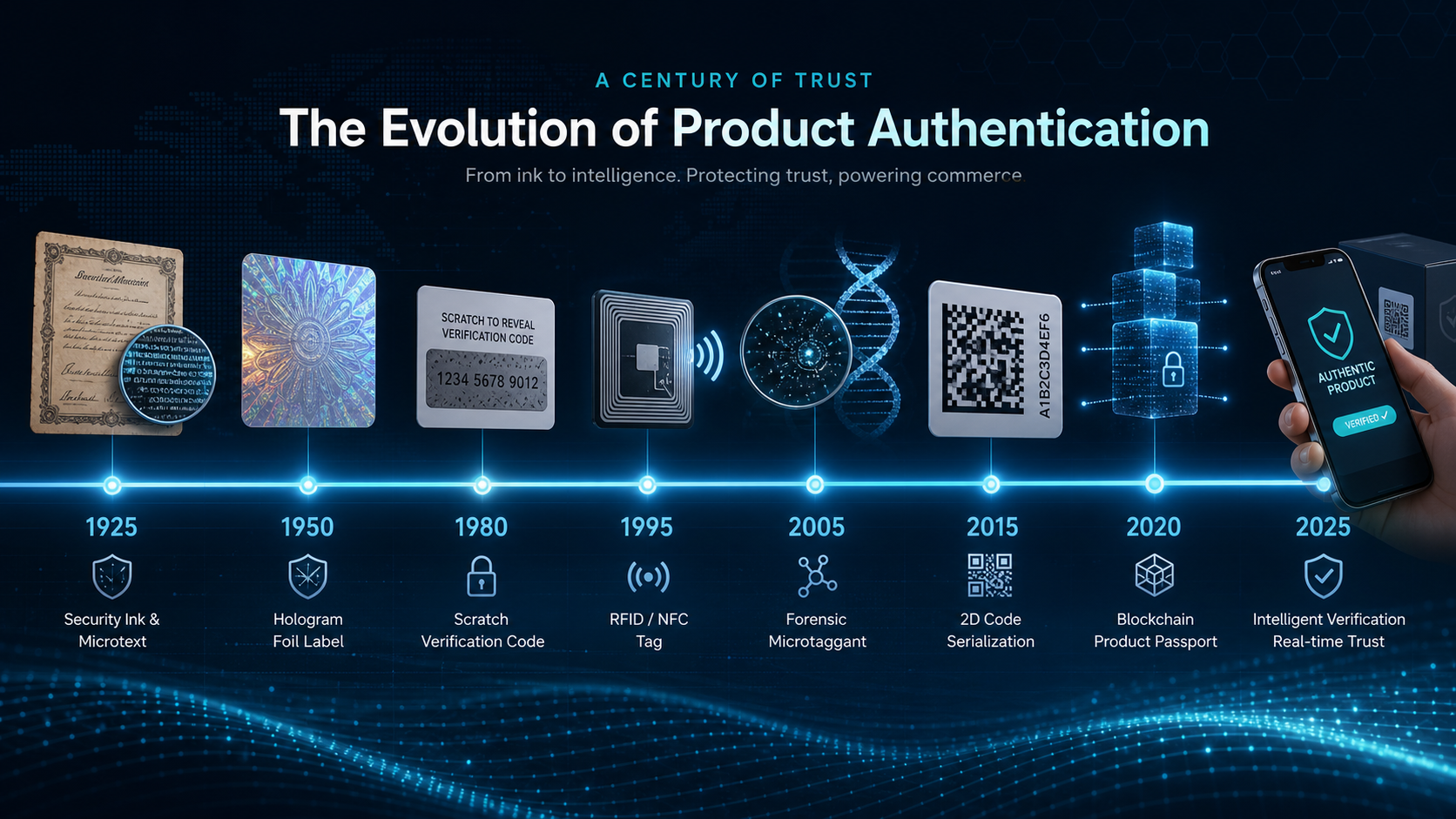
Each period added a new layer, but the strongest programs combine visible, covert, forensic, and digital verification.
Brands borrowed from banknotes: guilloche patterns, microtext, latent images, watermarks, special security fonts, and print details that blur when copied.
Embossed holographic foil moved from payment cards and passports into labels, cosmetics, software, watches, and pharmaceutical packaging.
Serial numbers, 2D Data Matrix codes, QR codes, and scratch-off SMS verification gave each unit a machine-readable identity.
Pharmaceutical rules such as the DSCSA and EU FMD pushed unit-level serial numbers, tamper-evident packaging, and pharmacy verification into the mainstream.
Blockchain product passports, NFC tags, AI authentication, and smartphone verification moved product identity from specialist tools into everyday customer scans.
Visible marks such as holograms, labels, and printed serials can still be useful, but they work best as part of a layered system. The methods that have aged best give each unit a unique identity, verify it at the point of use, and flag anomalies such as repeated scans or the same code appearing in impossible locations.
The anti-counterfeiting arms race moved from what people can see to what systems can verify.
The earliest modern product authentication methods came from currency and identity documents. Intaglio-style printing, guilloche line patterns, watermarks, microtext, latent images, and special fonts were adapted for labels, certificates, and packaging.
Special inks added another visible layer. Color-shifting inks change as the package is tilted, while ultraviolet and infrared inks stay hidden until a specific light source is used. These marks are useful because they are fast to check, but they are still static features.
The defining visible technology was the hologram. Holography was invented by Dennis Gabor in 1947, and rainbow holograms later made embossed foil practical for commercial use. Payment cards, passports, software, cosmetics, watches, and pharmaceutical packs all adopted holographic labels.
Holograms also exposed the weakness of visible security. Once the equipment became cheaper and skills spread, counterfeiters could imitate labels, remove real labels, or create convincing hologram-style marks. A feature that can be seen can also be studied.
The next leap was to give each product something a system could check. Serial numbers, batch codes, date codes, barcodes, QR codes, and 2D Data Matrix symbols made product identity machine-readable.
GS1 standards made these identifiers more interoperable by supporting global item numbers, serial numbers, batch data, and expiry dates inside compact codes. This became the backbone of modern pharmaceutical serialization and many consumer product traceability programs.
Scratch-off SMS verification solved a different problem: how to help consumers verify medicines in markets where smartphones were not yet universal. Services such as mPedigree and Sproxil printed unique hidden codes on packs so buyers could text a code and receive a genuine-or-suspicious result.
RFID and NFC then added wireless identity. A chip embedded in a label, tag, or product can carry a unique identifier and connect to a back-end record. These tags are useful for supply-chain visibility and resale, but they still need a trustworthy link between the physical item and the digital record.
When visible and machine-readable marks became easier to copy, high-risk categories turned to markers that are difficult to detect and nearly impossible to reproduce without knowing the secret.
Chemical taggants, spectral taggants, microscopic particles, and microtaggants can be added to ink, coating, raw material, fibers, or even product ingredients. A reader, microscope, or laboratory process can confirm the marker later.
DNA tagging is one of the strongest examples. Synthetic DNA sequences can be embedded into materials and verified by laboratory PCR analysis. These methods are powerful for customs, enforcement, court evidence, and supply-chain audits.
The limitation is convenience. Forensic markers are excellent proof for brands and authorities, but they are usually not something an ordinary shopper can verify at the shelf.
Pharmaceutical regulation changed the speed of adoption. The U.S. Drug Supply Chain Security Act created a phased path toward electronic, interoperable, unit-level tracing. The EU Falsified Medicines Directive required prescription packs to carry safety features and unique identifiers.
In the EU, prescription medicine packs carry a unique identifier encoded in a GS1 2D Data Matrix barcode plus a tamper-evident feature. Pharmacies verify and decommission codes against a medicines verification system at dispensing.
This moved authentication from optional brand protection to a shared industry requirement. Regulation forced the industry to create a standard that lets each pack be checked against a live record.
The latest phase connects the physical item to a digital record that customers, partners, resellers, and brands can use. Blockchain product passports support ownership and traceability records, especially in luxury and resale markets.
AI authentication adds another angle by treating the product itself as a fingerprint. Image-recognition tools compare microscopic visual features, construction details, and known reference data to identify suspicious items.
Smartphone QR and NFC verification makes the check accessible. A customer can scan at the point of purchase or use, while the back end checks product status, scan history, expiry, duplicate activity, and location anomalies.
Luxury, electronics, pharmaceuticals, and beauty all pushed different parts of the authentication stack forward.
Luxury brands moved from date codes and serial marks to holograms, RFID, NFC microchips, blockchain-backed certificates, and AI authentication. The challenge is that many chips and visible marks are not meaningfully consumer-verifiable on their own.
Electronics added authentication chips, engraved serial details, certified packaging marks, holographic warranty labels, and defense-grade forensic tagging where counterfeit components create safety and reliability risks.
Medicines now use the most legally mature stack: tamper-evident packaging, serialized 2D codes, pharmacy checks, and in some markets scratch-off SMS codes that customers can verify directly.
Cosmetics combine holograms, tamper-evident sleeves, UV inks, microtext, embossed packaging, QR/NFC labels, blockchain, and AI. Refilled genuine packaging remains a major risk, so destructible and tamper-evident labels matter.
No single method is best. Each option trades off cost, security strength, customer usability, and verification speed.
| Method | Layer | Key advantages | Key limitations |
|---|---|---|---|
| Security printing | Overt | Low-cost visible checks with microtext, guilloche, and latent images. | No unique identity, needs an expert eye, and skilled forgers can approximate it. |
| Special inks | Overt | Fast check with color-shift, UV, or IR effects. | May require a light source and does not prove the individual unit. |
| Holograms | Overt | Recognizable, difficult to photocopy, and inexpensive at scale. | Can be cloned, peeled, reused, or treated as proof when it is only a visible mark. |
| Tamper-evident seals | Physical | Shows opening, refilling, or substitution and helps customers spot interference. | Proves tampering risk, not authenticity by itself. |
| Serial numbers and date codes | Identifier | Simple, cheap, human-readable, and useful for records. | Static numbers can be copied, guessed, or reused across many fakes. |
| 2D Data Matrix and QR serialization | Track and trace | Supports per-unit identity, batch, expiry, smartphone scanning, and duplicate-scan detection. | Printed codes can be photographed, so the backend must detect copied-code behavior. |
| Scratch-off SMS codes | Consumer | Works on basic phones, supports per-pack checks, and has proven useful in emerging markets. | One-time reveal and depends on customers actually checking the code. |
| RFID and NFC tags | Electronic | Wireless read, hidden placement, encryption options, and supply-chain utility. | Higher cost and often limited consumer readability. |
| Chemical and spectral taggants | Forensic | Covert markers that are hard to reverse-engineer and useful as court-grade proof. | Requires a reader or lab and is not usually customer-facing. |
| DNA tagging | Forensic | Secret sequence can be extremely difficult to clone and can mark materials, fibers, or inks. | Slow and costly to verify compared with point-of-sale checks. |
| Blockchain product passports | Digital | Tamper-resistant records for ownership, traceability, resale, and product history. | The ledger is only as trustworthy as the physical-to-digital link. |
| AI authentication | Digital | Uses the product itself as a visual fingerprint and can improve with more reference data. | Needs training data and may still require a specialist service. |
| Smartphone QR/NFC verification | Digital | Lets buyers verify at the point of use and gives brands scan, expiry, and duplicate-code signals. | Static implementations are weak; the value comes from live validation and anomaly detection. |
Static packaging security still matters, but modern protection increasingly depends on live product identity.
Every product, batch, label, or tag needs its own identity instead of a copied generic mark.
Customers, partners, and inspectors should be able to verify a product in seconds without specialist equipment.
Repeated scans, unusual regions, expired products, and impossible scan patterns help reveal copied labels.
QR code product authentication connects a product QR code to a secure product record, then checks the scan against status, history, duplicate activity, and suspicious signals.
Static visible marks help, but copied marks eventually appear. Stronger systems give every product a unique identity, verify that identity against a live record, and watch for copied-code behavior such as repeated scans or impossible locations.
Yes, but they should be one layer, not the whole system. Holograms are recognizable and can discourage simple copying, but they can be imitated or reused and do not provide per-unit verification data.
Medicines carry direct safety risks, so regulators required stronger traceability. Rules such as DSCSA and EU FMD pushed the industry toward unit-level codes, tamper-evident features, and verification against shared systems.
QR verification is the modern consumer-facing layer. When each code is unique and checked against a backend, it can confirm product status and help detect copied labels through duplicate scans, expiry checks, and suspicious location patterns.
References used for the historical timeline, sector examples, and comparison of authentication methods.
Move from authentication history into the live TrustQR verification and anti-counterfeit pages.
TrustQR helps brands connect physical products to unique QR-based records, customer scan results, suspicious activity alerts, and duplicate-code detection.
These external references support the historical, technical, regulatory, and market context behind product authentication and anti-counterfeiting technology.