Create Product Codes
A brand creates products, batches, labels, or campaigns in TrustQR. Each item receives a unique digital identity that can be connected to packaging.
 TrustQR TrustQR
 Each product gets a digital identity. Customers scan the code, TrustQR checks the record, and brands receive useful scan intelligence without forcing customers to install an app.
TrustQR works by generating unique, secure QR codes for product batches, printing them on labels or packaging, and allowing customers to scan to verify authenticity with their smartphone. Brands track these scans and detect counterfeits in real time via a dashboard.
The TrustQR workflow is designed for real product operations, not just campaign landing pages.
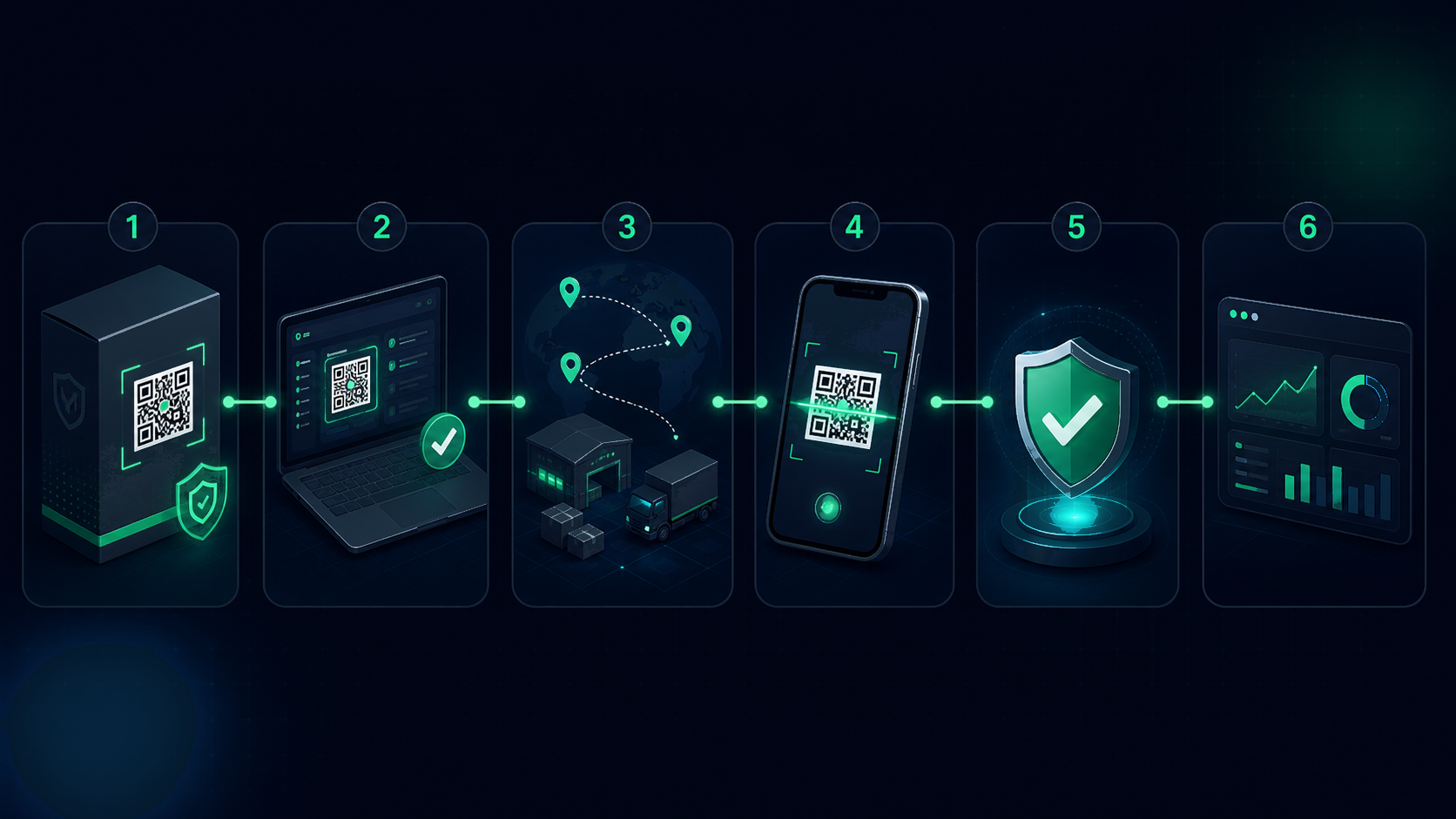
A brand creates products, batches, labels, or campaigns in TrustQR. Each item receives a unique digital identity that can be connected to packaging.
The secure QR code is printed on the product box, label, insert, or tamper-resistant seal so the item can be checked later by customers or partners.
Products move through distributors, retailers, marketplaces, and customer channels while the QR identity stays connected to the original product record.
A buyer scans the code with a normal phone camera and opens a TrustQR verification page without needing to install an app.
Verify authenticity, Authenticate product, and Detect counterfeits: TrustQR checks whether the code is valid, expired, previously scanned, copied, or suspicious based on product data and scan behavior.
The brand dashboard turns scan activity into useful signals such as duplicate scan alerts, regional activity, product engagement, and batch-level patterns.
TrustQR turns one scan into a fast authenticity signal and a useful brand data point.
Confirm whether the code belongs to a valid product, batch, or campaign.
Spot repeated scans that suggest copied packaging, shared codes, or suspicious resale behavior.
Set thresholds based on product value, geography, channel risk, or expected scan frequency.
Compare scan locations against expected markets and distribution patterns.
Product scans reveal customer interaction, geographic activity, market behavior, and optional contact collection.
Understand how often customers verify products and which product lines drive engagement.
View scan clusters by region to detect unexpected movement or counterfeit hotspots.
Compare verification behavior across SKUs, batches, campaigns, and markets.
All main TrustQR FAQ topics are collected here so customers, search engines, and answer engines can understand the platform clearly.
Core questions that apply across the TrustQR website.
TrustQR assigns unique QR codes to products, batches, labels, or campaigns. When a customer scans a code, TrustQR checks the product record, scan history, expiry status, duplicate scan signals, and suspicious activity patterns.
A printed QR code can be copied, but TrustQR watches for duplicate scans, strange locations, repeated behavior, and custom thresholds that make copied codes visible to the brand.
No. Customer verification scans are unlimited and included. Brands pay when they generate QR codes or contactless tags.
TrustQR can be used by brands that sell physical products, including supplements, cosmetics, food products, retail goods, electronics, and consumer products that need product verification.
Questions from the product verification system and product verification solution pages.
A product verification system helps determine whether a product is genuine by checking product identity, status, and supporting scan behavior.
A QR code links a product to a secure verification database. When scanned, the system checks product status, scan history, duplicate activity, expiry rules, and suspicious signals.
A product verification solution helps brands and consumers confirm product authenticity using product identifiers, QR codes, secure records, validation logic, and verification results.
A basic QR code may only open a link. A verification solution adds validation logic, scan history, duplicate detection, alerts, analytics, and customer-facing verification results.
Verification confirms product status against a record. Authentication validates legitimacy using secure identifiers and supporting checks such as scan behavior, product status, and security rules.
Duplicate scan detection can identify abnormal activity that may indicate copied packaging, shared codes, unauthorized resellers, or counterfeit products.
Yes. Brands can connect expiry and product status information to the verification result so customers see clearer product status.
Yes. TrustQR is designed to support multiple products, batches, brands, campaigns, and verification workflows.
Questions from the anti-counterfeit system page.
An anti-counterfeit system helps brands reduce counterfeit risks and improve product authenticity verification using identification, authentication, monitoring, and analytics.
They combine product serialization, secure QR codes, verification workflows, risk analysis, and brand-side intelligence.
QR codes can support verification and authentication workflows when connected to unique records, validation logic, and duplicate scan monitoring.
Duplicate scan detection identifies situations where the same code is scanned repeatedly, unexpectedly, or from unrelated regions.
Scan intelligence gives brands visibility into verification activity and suspicious behavior that static labels cannot provide.
No. Product verification can be completed using a standard smartphone browser.
They can help improve transparency and confidence by giving customers a clear way to verify authenticity.
Yes. TrustQR is designed to scale across products, batches, brands, and markets.
Questions from the brand protection page.
Brand protection is the process of protecting a company's products, customers, reputation, and revenue from counterfeiting, imitation, misuse, and unauthorized distribution.
TrustQR supports brand protection through QR code product verification, product authentication, duplicate scan detection, suspicious scan alerts, and scan analytics.
No. Small and growing brands can also benefit from product verification and anti-counterfeit monitoring.
QR code verification gives customers a simple way to check authenticity and gives brands visibility into scan activity.
Brand protection is the wider strategy. Product authentication is one tool within that strategy.
Yes. When customers can verify authenticity, they are more likely to trust the product and the brand.
TrustQR can help identify suspicious duplicate scan patterns that may indicate copied codes or counterfeit activity.
Yes. TrustQR provides scan history, scan analytics, and brand dashboard visibility.
Questions from pricing and implementation pages.
TrustQR uses usage-based pricing. Brands pay when they generate QR codes or contactless tags, while customer verification scans are unlimited and included.
Contactless tags are available as an added protection layer and are priced as an add-on to QR code generation volume.
Contactless tags are useful for premium, sensitive, regulated, high-value, or high-risk products that need stronger protection than printed QR codes alone.
No. Customer verification scans are unlimited and included. Brands pay for generated protection units such as QR codes or contactless tags.
Yes. TrustQR includes scan analytics, suspicious activity insights, and reporting tools for brand-side visibility.
Questions from the product authentication history page.
Static visible marks help, but copied marks eventually appear. Stronger systems give every product a unique identity, verify that identity against a live record, and watch for copied-code behavior.
Yes, but they should be one layer, not the whole system. Holograms are recognizable and can discourage simple copying, but they can be imitated or reused and do not provide per-unit verification data.
Medicines carry direct safety risks, so regulators required stronger traceability through unit-level codes, tamper-evident features, and verification against shared systems.
QR verification is the modern consumer-facing layer. When each code is unique and checked against a backend, it can confirm product status and help detect copied labels.
Explore duplicate scan detection, scan analytics, location signals, contactless tags, and brand protection controls.
See how products connect to digital verification records and how customers receive clear authenticity results.
Compare usage-based pricing for QR code verification and contactless tag protection.
TrustQR helps brands verify product authenticity, detect suspicious scans, and protect customers from counterfeit products.
These references provide technical context for QR code symbology, product identity, and web-enabled product information. They support the standards background behind QR-based product verification.